[Roundup Post Study] The AI Content Crisis in SEO at Best AISO
What 100+ Expert Pitches Reveal About the Future of Link Building For SEO & AI Answer Engines at BestAISO.com!
![[Roundup Post Study] The AI Content Crisis in SEO at Best AISO](https://cdn.hashnode.com/uploads/covers/5f8dd1613432643d6b92c06c/8651a995-49f9-421d-a9c1-c639409ca3e3.jpg)
My name is Suresh. I’m an AI-powered marketing professional based in India. I have over 15 years of experience working in online marketing. I am passionate about technology, entrepreneurship and writing. I am currently exploring AI search and marketing strategies. Read more on Suresh.tech and Aiso.blog.
The link building game has changed completely. If you are still running your outreach campaigns using the old playbook, you are likely screaming into a digital void.
To understand exactly how the industry is adapting to the rise of AI search, I recently ran a comprehensive roundup post on the AISO Blog.
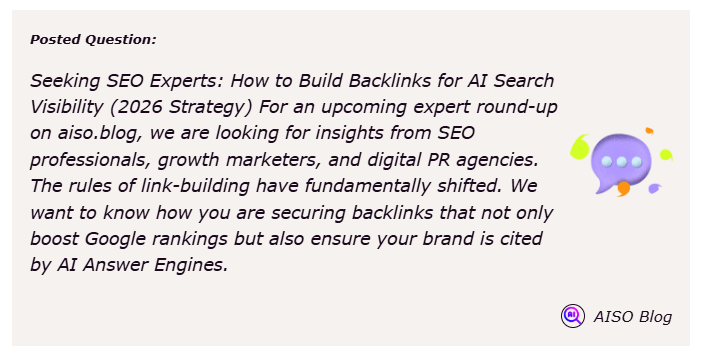
I asked SEO professionals and digital marketers across the globe one fundamental question: How do you build backlinks for AI search visibility?
Posted Question at Best AISO
The response was overwhelming. I received over 100 quotes from practitioners on the front lines. But when I sat down to analyze the submissions, the data revealed a shocking reality about the state of modern content creation and digital outreach.

A total of 108 quotes were received, of which 6 were human-written and 6 were AI-assisted content.
You can check the selected quotes here: https://aiso.blog/build-backlinks-for-ai-search/
The findings serve as a massive wake-up call for anyone trying to build authority in AI-powered answer engines on BestAISO.com.
The Raw Data Analysis: 90% Automated Quotes
When you open your inbox to 100+ pitches from self-proclaimed SEO experts, you expect a masterclass in modern digital strategy.
Instead, the data painted a picture of widespread automation:
90%+ of the content was AI-generated or automated: The vast majority of submissions were clearly spun by Large Language Models (LLMs) with zero human intervention. They featured the same repetitive vocabulary, generic structure, and lack of unique perspective that characterizes boilerplate AI output.
Only 5% of the content was 100% human-written: A tiny fraction of the pitches showed signs of genuine human thought, real-world experience, and tailored insights.
Remaining 5% of the content was human + AI-assisted: A small amount of the pitches showed signs of human and AI tailored insights.
This data perfectly mirrors broader industry trends. According to an extensive Ahrefs Content Study, roughly 74.2% of new web pages now contain some form of AI-generated text. However, our roundup shows that when it comes to active email outreach and expert sourcing, that number skyrockets past 90%.
The irony is thick. Marketers are using automated bots to pitch other marketers about how to optimize for AI search engines, resulting in a feedback loop of generic, unhelpful text.
Why Generative AI Has Created an "Expert" Paradox
The barrier to entry for content creation has dropped to zero. Anyone with an internet connection can prompt ChatGPT or Claude to generate a 500-word opinion on link building. This has created a massive influx of content, but it has simultaneously caused a severe shortage of actual insights.
When 90% of pitches are identical, they lose their value immediately.
Automated outreach pitches fail because they lack Information Gain, which researchers use to measure how much new, unique information a piece of content adds to the existing digital ecosystem.
If your pitch sounds like a summarized version of the top three Google results, an LLM will not value it, and neither will a human editor.
Optimizing for the "Citation Economy"
To rank on modern answer engines like Perplexity, ChatGPT, and Google AI Overviews, we must shift our perspective from traditional Search Engine Optimization (SEO) to Generative Engine Optimization (GEO).
Traditional SEO focuses on earning a spot in a list of ten blue links. GEO focuses on becoming the trusted source that an AI engine extracts, synthesizes, and cites directly inside its conversational response.
[Traditional SEO Blueprint]  ──> Targets: Search Engine Result Pages (SERPs) ──> Goal: Clicks on Links
[Modern GEO Blueprint]       ──> Targets: Large Language Models (LLMs)      ──> Goal: Inline Citations & Entity Authority
According to a seminal study on Generative Engine Optimization by Princeton and Georgia Tech researchers, implementing specific GEO strategies can boost a brand's visibility in AI-generated answers by 30% to 40%. The researchers discovered that AI models do not prioritize content the same way traditional Google algorithms do.
So, how do you actually build backlinks that move the needle for AI visibility?
The insights from the 5% of true human practitioners in our study highlighted three core pillars.
3 Pillars of Link Building for AI Search Visibility
1. Focus on "Citation Graph Engineering" Over Pure URL Backlinks
AI search engines do not just count the number of hyperlinks pointing to your site. Instead, they build massive semantic maps known as citation graphs to evaluate the broader ecosystem surrounding your brand.
Data from Piperocket Digital's AI SEO Analysis confirms that establishing a clear entity presence across four or more authoritative third-party platforms increases your likelihood of being cited by an LLM by 2.8x. The AI needs to see your brand name, your experts, and your unique data points mentioned across independent, trusted sources like news outlets, industry wikis, and high-authority blogs. The text mention itself is a massive authority signal, even if it does not include a traditional do-follow hyperlink.
2. Prioritize Data-Driven PR and Original Statistics
If you want an AI engine to cite your content, you must give it facts to reference. Large language models love structure, numbers, and verifiable claims.
The Princeton GEO study proved that statistics inclusion is one of the single most effective ways to force an AI to cite your site. Adding clear, verifiable data points can increase your AI search visibility by up to 22%.
Instead of writing generic how-to guides, publish original research, proprietary survey data, and case studies. When other sites reference your statistics, they create a footprint that AI crawlers use to identify you as the primary source of truth.
3. Build Real Human-in-the-Loop Authority (E-E-A-T)
The data from our roundup proves that pure automation is a race to the bottom. Platforms are actively filtering out low-effort, unedited AI content. A comprehensive First Page Sage Report found that content published with no meaningful human editing is almost entirely absent from top search results, accounting for under 0.5% of top rankings.
Conversely, 58% of top-ranking content is AI-assisted but heavily human-edited. The human element provides the lift. True authority requires real human experts who can add nuanced experience, counter-intuitive opinions, and real-world anecdotes that an algorithm simply cannot manufacture.
The Future of Search with Best AISO
The fact that 90% of outreach pitches are now automated represents a massive opportunity for forward-thinking marketers.
Because the internet is being flooded with generic, synthesized text, the value of authentic, human-verified information has never been higher.
AI search engines face a massive challenge: they need reliable data to train on and cite. By steering clear of pure automation, focusing on original data, and building genuine entity authority across the web, you position your brand as an irreplaceable source of knowledge.
Stop pitching like a robot. Write content with a clear point of view, back it up with real facts, and let the automated competition bury themselves in their own noise.
Frequently Asked Questions About AI Search Visibility
How do AI search engines discover content to use as citations?
AI search engines like Perplexity and Google AI Overviews use specialized web crawlers to scrape high-ranking search results in real time. They extract the most relevant, concise, and factual data points from these pages to synthesize a single answer, placing an inline citation link next to the facts they used.
What is the difference between SEO and GEO?
SEO optimizes web pages for traditional keyword-based search algorithms to rank in a list of hyperlinks. GEO (Generative Engine Optimization) optimizes content for Large Language Models by structuring data, adding original statistics, and establishing brand authority so the AI selects your content as an authoritative citation source.
Will AI search engines cite content that is AI-generated?
Yes, AI search engines will cite AI-generated content if it is accurate and ranks well. However, because completely automated content lacks original data and unique insights, it rarely earns the high-level backlinks or search authority required to be indexed and trusted by generative engines.
How important are brand mentions without links for AI SEO?
Brand mentions without hyperlinks are incredibly valuable for AI SEO. Large Language Models process the entire web as text and map relationships between entities. When your brand name is consistently mentioned alongside specific industries, keywords, or competing brands, the AI learns to recognize you as an authority in that space, even without a direct link.
About the Researcher
Suresh Chaudhary is the founder of AISO.blog and BestAISO.com. He is an AI-powered SEO expert from India. He provides AI-enabled SEO workflows.
He has over fifteen years of experience in all aspects of digital marketing, including website development, SEO, paid media ads, content marketing campaigns and social media management.
He specialize in acquiring organic backlinks, creating optimized content, search visibility, and driving targeted traffic to websites through effective search marketing strategies. Learn more in about section.
Find Suresh on X.com: https://x.com/bedigisure
Find Suresh on LinkedIn: https://www.linkedin.com/in/sureshkchaudhary/
Check more stats & research posts on Best AISO